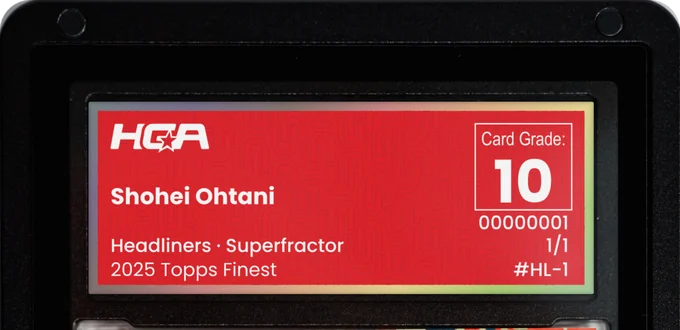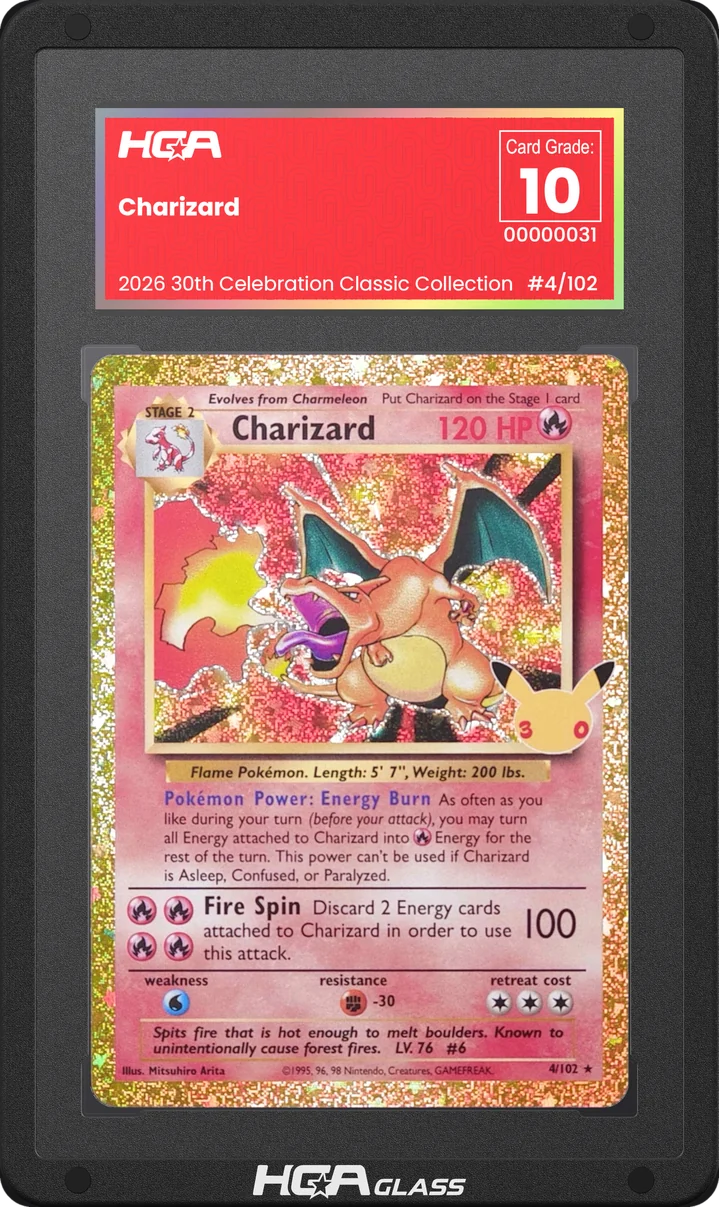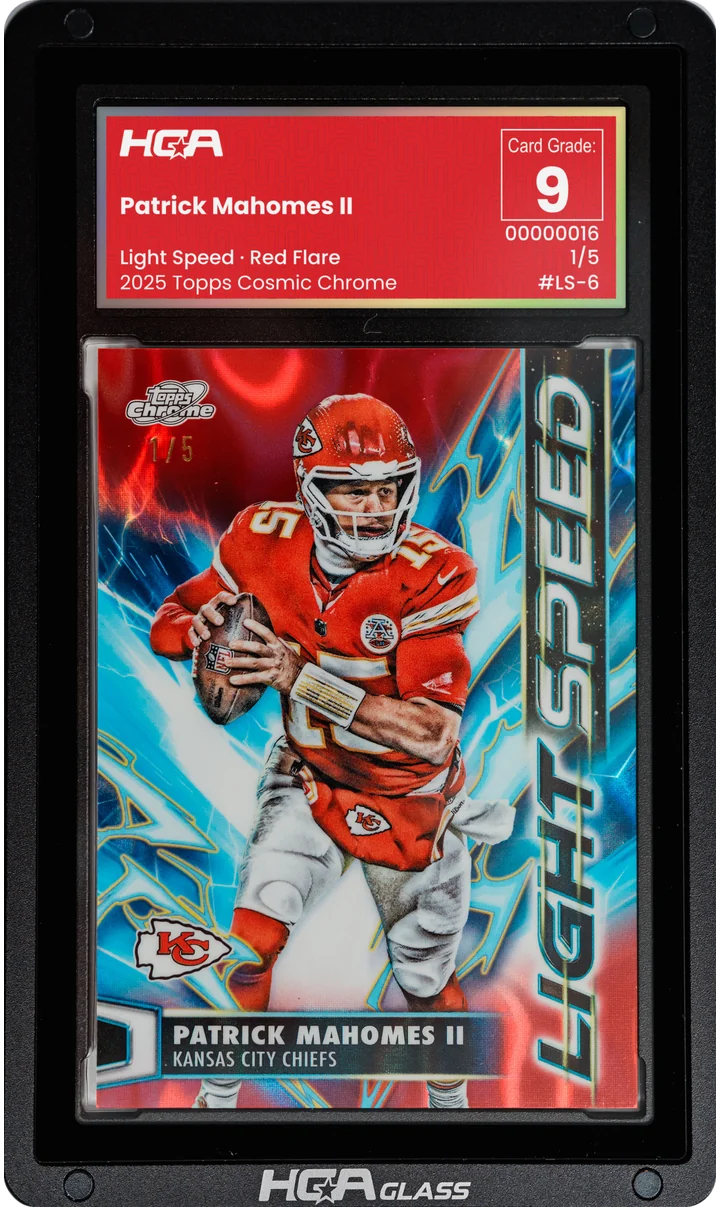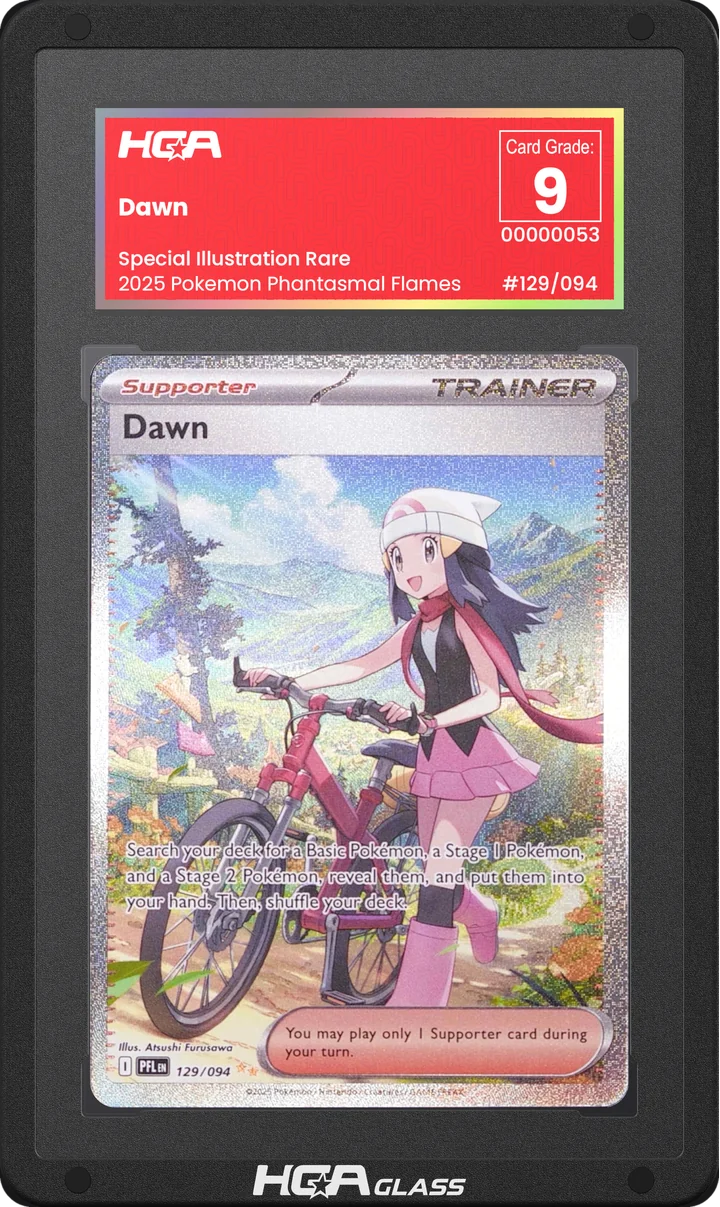
10Flawless
A perfect card with no flaws. Centering, corners, edges and surface each earned a 10. It receives the gold label. No card is rounded up to this grade.
Centering55/45 or better front · 75/25 or better back
AllowancesNone.
Grading standards · HGA Standard v2026.2 · In effect today
Grading shouldn't be a black box. This is our standard, in glass: how we handle your cards, the full scale, every severity level and threshold, how the grade is calculated, how each subgrade is inspected, and exactly what you get back.
The process
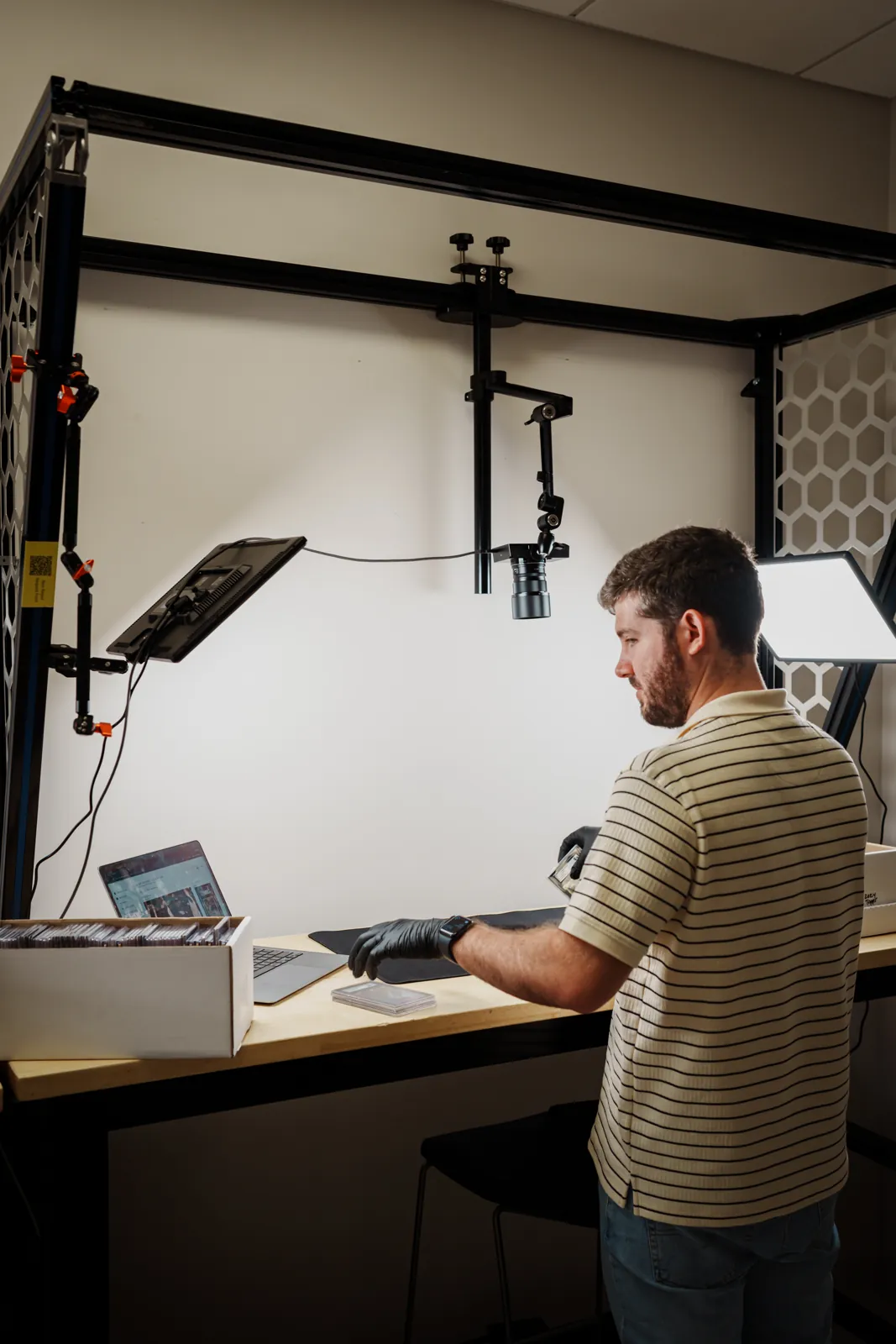
Every step is tracked live in your portal. Turnaround counts from your grading date.
Box photographed, condition recorded.
PhotoEvery card removed on video, barcoded and tracked. A missing card is refunded automatically.
VideoHigh resolution images of both faces. Identity confirmed by a person. Authentication checks.
ImagesCentering set by the published scale. Graded by someone who never knows whose card it is, released by a senior grader.
StatusHoused in the case you chose. The RFID chip is written to the record; label, record and card verified; final images taken.
ImagesTurn each slab over live. Then decide within 7 days: ship home, list, or vault.
LiveThe scale
Your card grade is a whole number, 1 to 10. No plus, minus or half points on the overall grade. The precision lives in the four subgrades, published on every label.
Your grade is a number, 1 to 10. Prefer no number? Ask for Authentic: confirmed genuine and unaltered, housed with an Authentic label.
Centering, corners, edges and surface. Each scored on its own and published on every label. Centering is measured, and it can cap the grade.
A 10 with all four subgrades at 10 earns Flawless: the highest mark a card can carry, its own label, and HGA Glass at no charge.
Severity levels
Every HGA grade is built the same way. We inspect the card, classify each flaw we find, and rate how severe it is. Those ratings, together with centering, determine the grade.
We examine the corners, edges and surface of every card, front and back.
Each flaw is identified by type, such as a scratch, corner wear or a print line.
Each flaw is given one of five severity levels, based on how easy it is to see and how much it affects the card.
| Level | What it means |
|---|---|
| Trace | Found only through professional inspection. |
| Minor | Visible on close inspection. |
| Moderate | Noticeable at a normal viewing distance. |
| Severe | Apparent at a glance. Some flaws are always rated severe, no matter how small. |
| Damage | The card’s structure is compromised. |
Each grade is defined by the severity levels it allows. The front is the display side of the card, so flaws on the front always carry more weight than the same flaws on the back. Centering is measured separately and sets its own limit on the grade.
How the grade is calculated
Every card receives four subgrades: centering, corners, edges and surface. Three rules turn them into the overall grade.
A card’s overall grade cannot be higher than its centering subgrade. The one exception is the gem band: a card with 9.5 centering can earn a 10 when its other three subgrades are 9.5 or higher.
A card’s overall grade cannot be lower than its lowest subgrade. Overall grades are whole numbers, so a lowest subgrade that ends in a half point rounds up: an 8.5 becomes a 9.
When the other three subgrades are each at least one full point above the lowest, the card is considered for one grade higher. Eye appeal decides it: our graders judge whether the card presents at the higher grade. A card never moves up more than one grade, and never above its centering subgrade. A 10 is earned this way only with one subgrade at 9 and the other three at 10.
Example: a card with centering 9, corners 9, edges 9 and surface 8 has a floor of 8. Because the other three subgrades are a full point higher, it is considered for a 9, and eye appeal decides whether it earns it.
Eye appeal: the rules decide when a card sits between two grades. Eye appeal decides which one it earns. This keeps grading consistent from card to card, while leaving room for a trained grader’s judgment where the scale allows it.
What each grade looks like
Each grade is defined by the severity levels it allows. Centering minimums are listed where they apply.
A perfect card with no flaws. Centering, corners, edges and surface each earned a 10. It receives the gold label. No card is rounded up to this grade.
Centering55/45 or better front · 75/25 or better back
AllowancesNone.
A nearly perfect card with sharp corners, crisp focus and full original gloss. Its flaws are trace-level, with at most one minor flaw.
Centering55/45 or better front · 75/25 or better back
A card in superb condition that looks pack-fresh in hand. Typically a card that went straight from the pack into protection.
Centering65/35 or better front · 90/10 or better back
A card that presents as Mint at first glance, with flaws that appear on closer inspection. Typically a carefully kept card that picked up light wear before it was protected.
Centering70/30 or better front · 95/5 or better back
A card with evident light handling that retains strong overall appeal. Typically a card that was stored well but handled over time.
Centering75/25 or better front · no back minimum
A card with visible wear that remains attractive. Typically a card that was handled regularly or stored loose.
CenteringNo minimum.
A card with clear wear that still displays well. Typically a card that spent years in a collection without protection.
A card with pronounced wear that retains some eye appeal. Typically a card that was handled often, sorted, traded or stacked.
A card with heavy wear that is still whole and easy to recognize. Typically a well-used card with rounded corners and little of its original gloss.
A well-worn card with obvious damage. Typically a card that saw years of rough handling, with the image still complete.
The lowest grade. A heavily damaged card with almost no eye appeal, graded so it can be housed, recorded and protected.
No numerical grade. Available on request in place of grading. The card is examined by HGA, confirmed genuine and unaltered, and housed with an Authentic label.
Never gradedAltered cards are not authenticated or encapsulated. Any sign of trimming, recoloring, repair or cleaning sends the card to our authentication team before it receives a grade.
The four subgrades
Every subgrade is scored on its own, 1 to 10, and printed on the back of the label. This is how each one is inspected and what each score means.
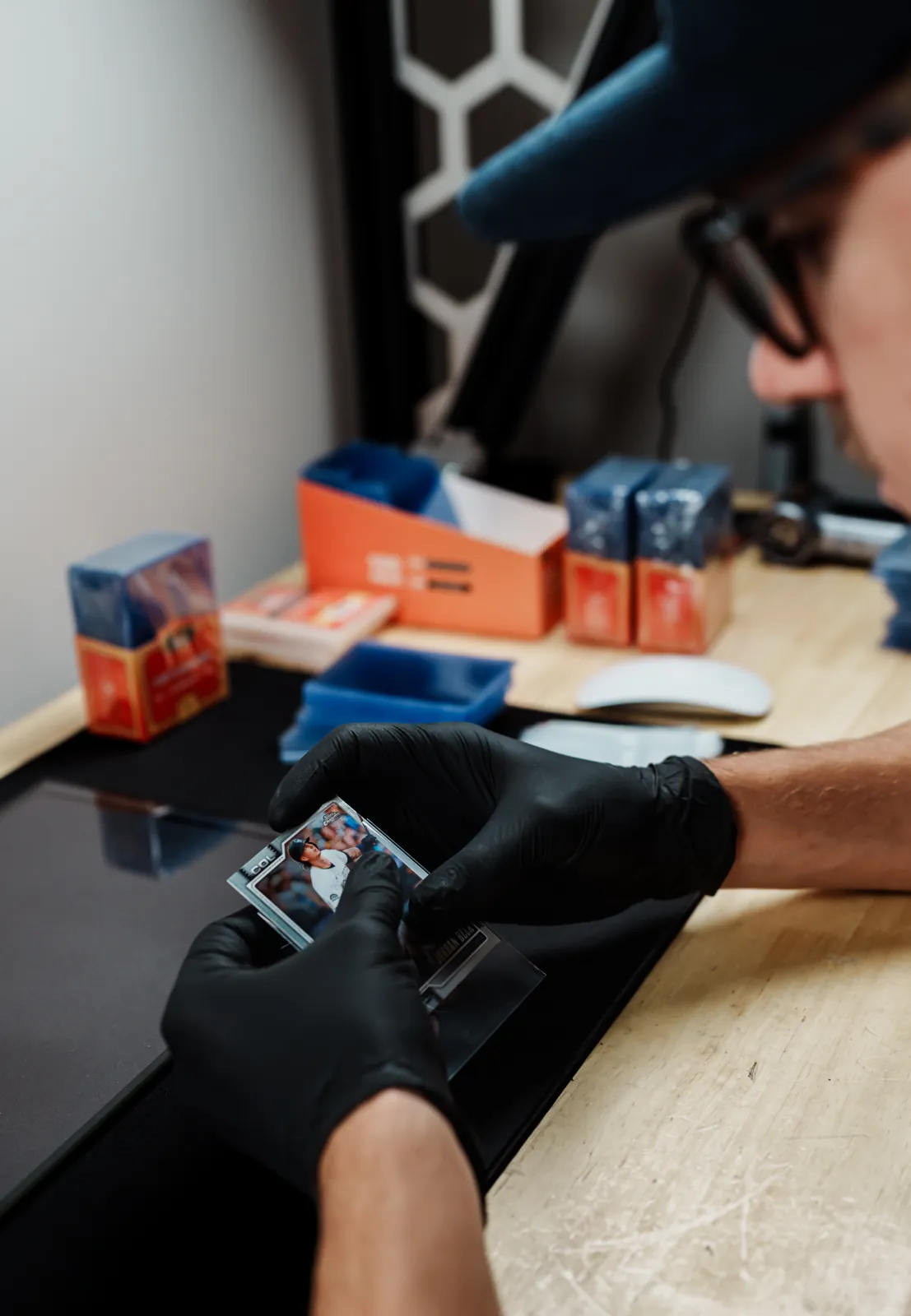
Subgrade 1 · Centering
We use a digital centering tool to measure each card's borders on the front and the back, and our graders confirm those measurements by hand. Because centering comes from how the card was cut at the factory, it carries extra weight and can limit a card's overall grade, however clean the rest of the card is.
| Front measurement | Centering grade |
|---|---|
| 50.00/50.00 through 55.00/45.00 | 10 |
| 55.01/44.99 through 59.99/40.01 Gem band | 9.5 |
| 60.00/40.00 through 65.00/35.00 | 9 |
| 65.01/34.99 through 70.00/30.00 | 8 |
| 70.01/29.99 through 75.00/25.00 | 7 |
| 75.01/24.99 or worse | 6 |
| Back measurement | Highest centering grade |
|---|---|
| 50.00/50.00 through 75.00/25.00 | 10 |
| 75.01/24.99 through 90.00/10.00 | 9 |
| 90.01/9.99 through 95.00/5.00 | 8 |
| 95.01/4.99 or worse | 7 |
Centering standards are often published as approximate ranges, with the final call left to the grader. HGA measures every card to two decimals and grades it against fixed lines.
The front carries more weight here too. The front measurement sets the centering grade, and the back measurement sets the highest grade it can be.
A front between 55.01/44.99 and 59.99/40.01 scores 9.5 on centering. Whether the card is a 10 or a 9 then comes down to the rest of the card.
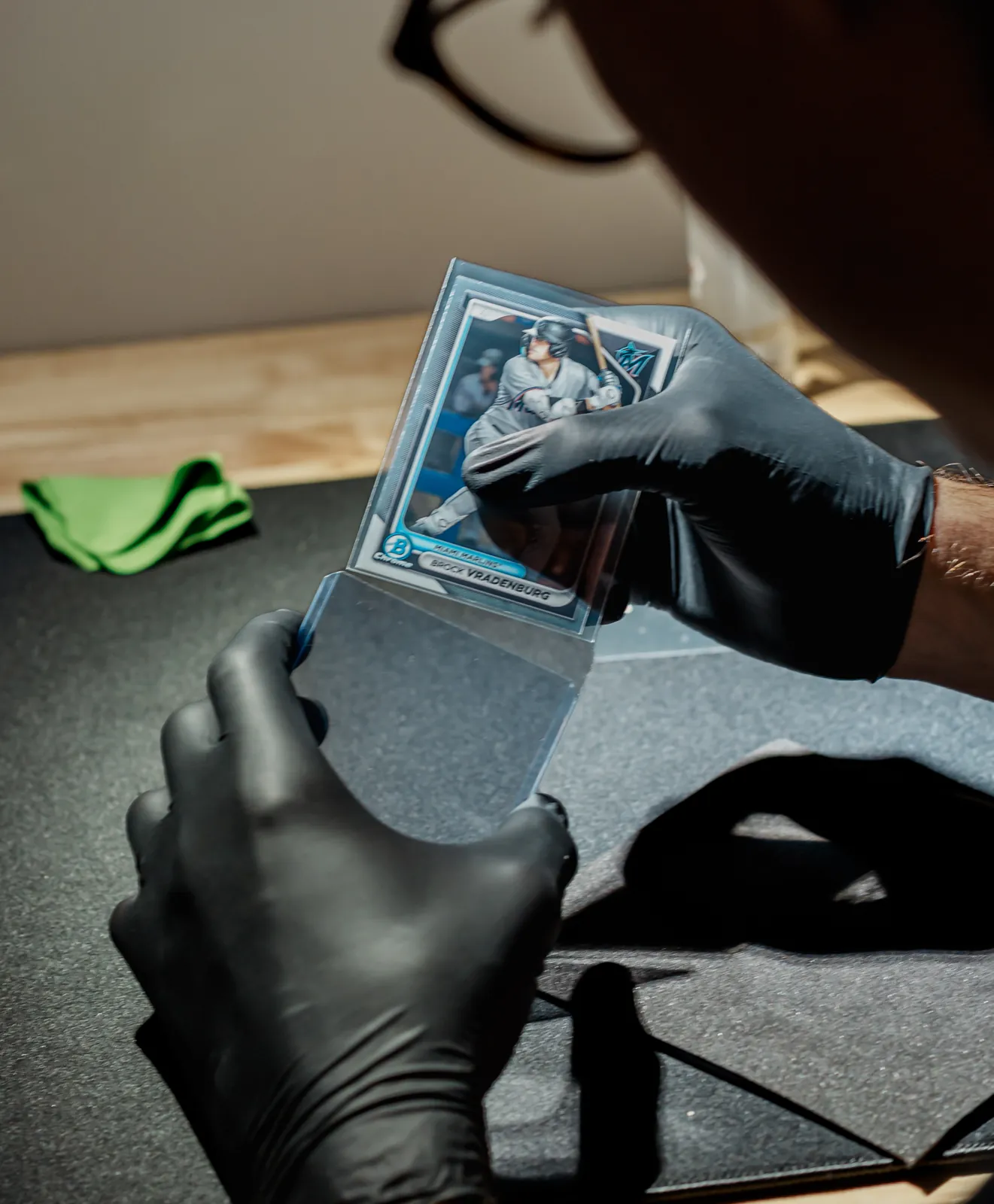
Subgrade 2 · Surface
We inspect the full surface of every card, front and back, under controlled lighting and magnification, and tilt each card to catch flaws that don’t show straight on. We look for factory flaws (print lines, print spots, focus problems) and handling wear (scratches, scuffs, stains, dents, wrinkles, creases).
The front is the display side of the card, so it carries more weight than the back. Flaws on the front stand out more, and the grade reflects that.
Every finding is located on the card image in the Grade Report.
What each level looks like
Surface scale
Surface is graded in half points. A half point sits between two whole grades and shares qualities of both. For example, a 9.5 shows only trace flaws or a single minor flaw.
None. Full original gloss and no staining.
A few minor flaws: a light scratch or a light print line.
Several minor flaws, or one moderate flaw: a noticeable scratch or a moderate print line.
A few moderate flaws: a deep scratch, a large, noticeable printing mark, slight gloss loss, a light wax stain on the back.
Several moderate flaws, or one severe flaw: a heavy print line, some gloss loss, a wrinkle.
A few severe flaws: clearly dulled gloss, a crease.
Several severe flaws: surface layers starting to peel, a spot of missing surface, a clear crease.
Severe flaws throughout, or damage in one area: a stain on the front, most of the gloss gone, a deep crease.
Damage in several areas: chipped color, more than one crease, gloss gone entirely.
Damage throughout: creases that nearly break through the card, heavy discoloration, warping, a missing piece.
On the surface subgrade, a wrinkle is first allowed at a 6 and a crease at a 5.
Subgrade 3 · Corners
Every card gets a corner-by-corner inspection: all four corners, front and back, under magnification. We look for rounding, fraying, dings, whitening and layers starting to separate, and weigh how easy each flaw is to see, how much of the corner it covers and how many corners it shows up on.
The front is the display side of the card, so it carries more weight than the back. Corner flaws on the front stand out more, and the grade reflects that.
Any sign of trimming or touched-up corners sends the card to our authentication team first.
What each level looks like
Corners scale
Corners are graded in half points. A half point sits between two whole grades and shares qualities of both. For example, a 9.5 shows only trace flaws or a single minor flaw.
None. All four corners sharp, front and back.
A few minor flaws: slight wear limited to one corner, with the rest sharp.
Several minor flaws, or one moderate flaw: light fraying or a touch of softness at one or two corners.
A few moderate flaws: worn corners visible at arm’s length, on more than one corner. Not yet rounded.
Several moderate flaws, or one severe flaw: corners starting to round, or one hard corner ding.
A few severe flaws: rounding on more than one corner, or one badly crushed corner.
Several severe flaws: clearly rounded corners with visible fraying.
Severe flaws throughout, or damage in one area: clear rounding on every corner.
Damage in several areas: advanced rounding, with corners fraying or separating in layers.
Damage throughout: corners badly worn, torn or missing pieces.
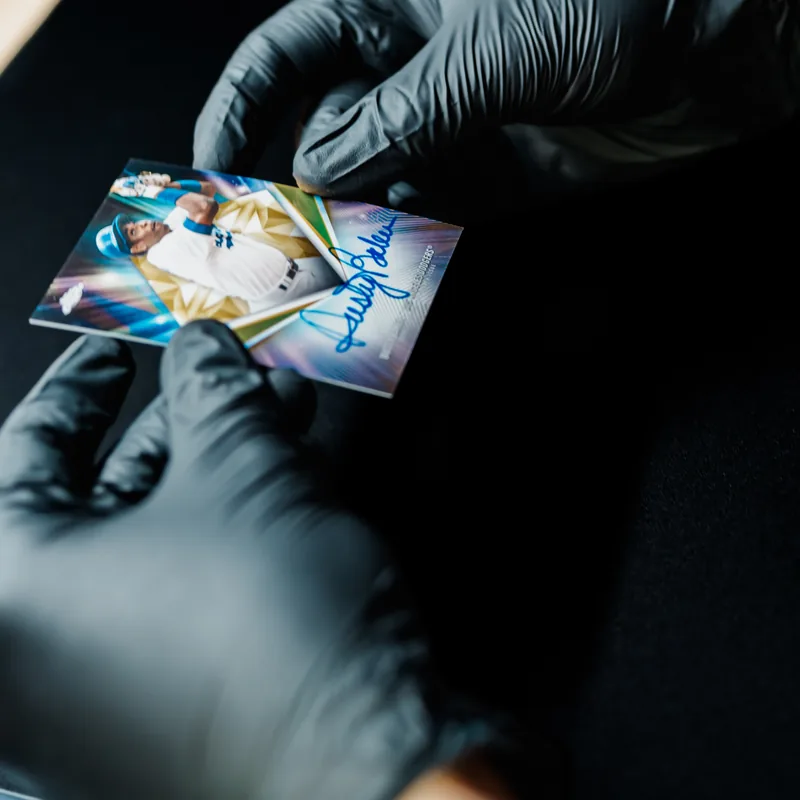
Subgrade 4 · Edges
We inspect all four edges, front and back, in the same order every time, end to end. Graders use a controlled light, a loupe and their fingertips, since some edge flaws are easier to feel than to see. We look for whitening, chipping, fraying, dents, peeling and discoloration.
The front is the display side of the card, so it carries more weight than the back. Edge flaws on the front stand out more, and the grade reflects that.
A slightly rough factory cut is noted, but doesn’t count against the card the way wear does. Any sign of trimming, repair or chemical cleaning sends the card to our authentication team first.
What each level looks like
Edges scale
Edges are graded in half points. A half point sits between two whole grades and shares qualities of both. For example, a 9.5 shows only trace flaws or a single minor flaw.
None. Clean, smooth, fully colored edges on all four sides, front and back.
A few minor flaws: slight edge wear limited to one place.
Several minor flaws, or one moderate flaw: light edge wear in more than one area.
A few moderate flaws: worn edges visible at arm’s length.
Several moderate flaws, or one severe flaw: chipping and small nicks along one edge.
A few severe flaws: small chips along the edges, or a split edge.
Several severe flaws: chipping on more than one edge, with some color loss.
Severe flaws throughout, or damage in one area: edges worn along their length, with fraying and color loss.
Damage in several areas: heavily worn, chipped or notched edges on most sides.
Damage throughout: torn, broken or badly damaged edges.
Autograph
Every autograph is authenticated first, then graded for strength, placement and condition. A 10 goes on the front label. Anything less stays in the Grade Report, off the label. It can only help the card, never hurt it.
Bold, complete and fully on the card. Even ink, clean lines, no smudging, skipping or bleed.
Strong and complete. Slight thinning, a small skip, or placement that crowds the design.
Faded, smudged, streaky, incomplete, or running off the card. Recorded in the report; the label stays clean.
Blind grading
Who sent a card has no bearing on its grade. Not a dealer, not a big account, not a name the grader recognizes.
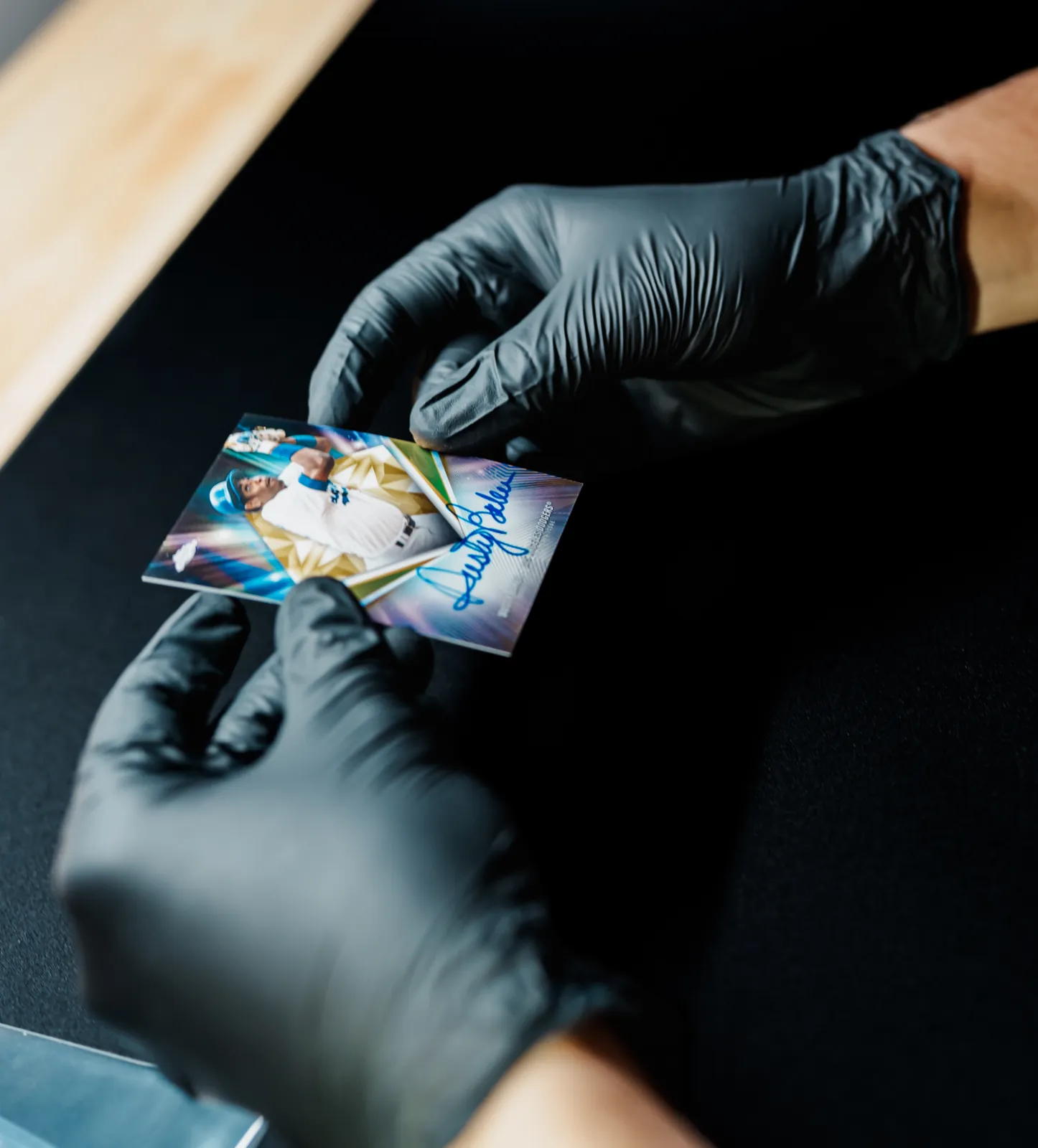
The grader sees the card and its record, never the submitter.
Every finding is recorded against this published standard. The grade is set from the record; the grader never types a number.
A senior grader reviews and releases every grade as the named releaser. Every edit is logged.
The Grade Report
Each finding placed on the card image with its severity, in plain words.
High resolution images of both faces, and the sealed slab, kept with the record.
The report opens from the cert lookup and stays with the card in My Cards.
Written to a record no one can alter and tied to the chip in the label.
Policies
Your cards are graded on the date you book. Turnaround from that date until your cards are back with you is 30 business days for Glass and oversized cards and 60 for Poly cards and booklets, counted on the US federal holiday calendar.
Never graded, never cased. Inconclusive after senior review: returned ungraded, fee refunded.
Support is built into your portal. Ask about any grade from the card itself. There is no formal appeal.
If we lose or damage a card in our possession, we replace it or pay you for it. Every step is documented in your portal.
No upcharge up to $10,000 in card value. Above that, a 2.5% fee on the value over $10,000 only, paid when you book your grading day. Shipping insurance is 1% of the card's value on cards worth more than $500, charged when you book.
Legacy HGA slabs return for recertification to the new standard and housings. Legacy HGA
Seen enough?
HGA Glass at $200 a card, or Poly at $30, until February 28.